I’ve driven and camped across the Nullarbor a few times … strangely enough every 21 years since 1978 … when, having completed a desultory arts degree at Macquarie, I set off with a friend in a $200 EH station wagon to work for Transfield constructing an iron-ore beneficiation plant in Newman (1180 km north of Perth). Subsequent road trips (the first with two young boys strapped into our old blue Merc) revolved around visiting my partner Denise’s family in Albany.
It all seems a very long time ago, now, but in the Pilbara I can still vividly remember Mori, our generous, funny Sicilian foreman and my fellow workmates … a potpourri of newly-arrived European immigrants including Phil (a crane driver/ex-football hooligan from Birmingham), Miro, a spirited young Yugoslav handy with a knife (with whom we often played pool) and Bonar (a connoisseur of locally-available drugs, named apparently after the British Conservative prime minister Bonar Law). Mori, who'd worked ‘over east’ in his younger days, for BHP at Port Kembla, once boasted quietly to me that he and a few Italian compatriots had in effect founded Transfield by hiring out BHP machinery and equipment at night!
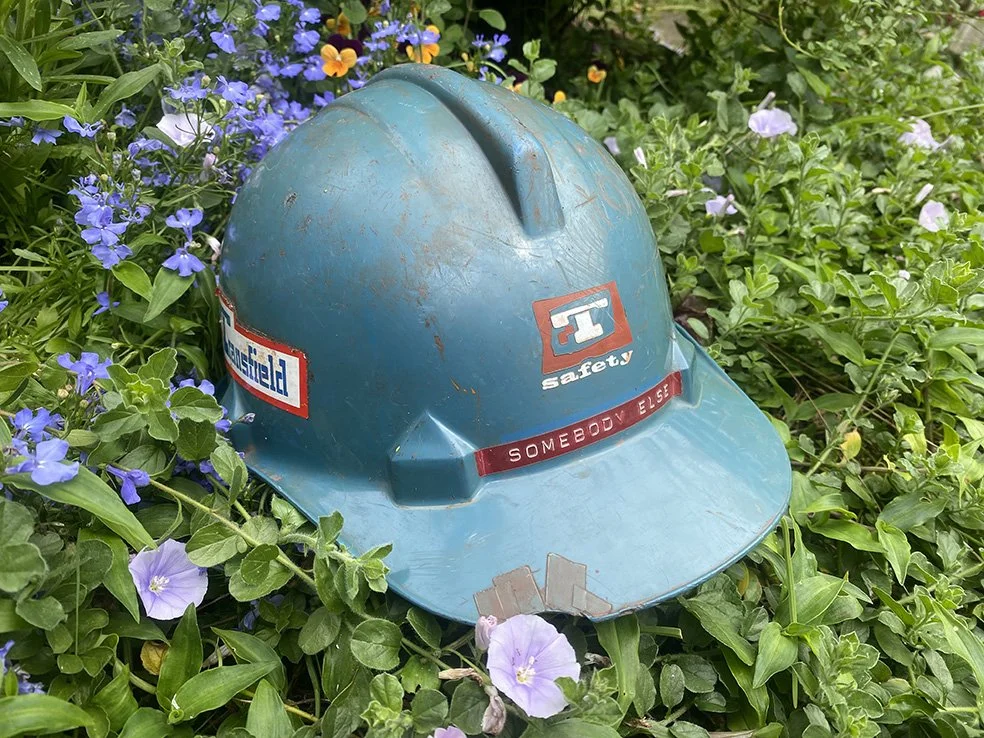
As a playful Anglo whippersnapper intent on stamping (whilst obscuring) his own identity on site in Newman, I’d printed out and stuck a DYMO label with the vaguely-foreign-sounding moniker 'A. Nobody’ to my helmet, and to this day I can hear Mori calling out to me across the steel in his cadenced new-Australian accent … 'hey, Nobody, come over here’. Having survived my city-boy baptism with Transfield – ramming tons of red aggregate beneath a massive corrugated-iron culvert with a heavy compactor for a week – I morphed into 'Somebody Else’, working first as a lift attendant (my external ‘cage’ looking out upon a snaking line of iron-ore trains, from whence I was able to enjoy snatches of The Philosophy of Andy Warhol [From A to B and Back Again] between clients), and later as a dogman unloading trucks of pre-fabricated steel from Kwinana.
Almost five decades on from those formative WA months ‘up north’… in September this year Denise & I flew to Perth, hired a small Czech sedan and headed south to visit her now-elderly mum Alice, in Albany/Kinjarling. Between family engagements and some odd jobs around the house we hoped to splice in a little cycling beneath tall timbers (the Munda Biddi Trail?) and (on the way back to Perth) check out the Stirling Range and Dryandra Woodland national parks to the north …
Years ago I’d read Dryandra: The Story of an Australian Forest (1970), Vincent Serventy’s account of the changing seasons and small wonders of its extensive wandoo woodlands. The book had taken on a Walden-like aura, bringing to mind Thoreau’s famed pronouncement ‘In wildness is the preservation of the world’. But what I hadn’t clocked was that Vincent’s book basically saved Dryandra from (bauxite) mining at the hands of a then-relatively-young Rupert Murdoch (see base of panel below)! So it was quite marvellous, after several failed attempts this century, to flick on our eastern-European indicator, to turn off the Great Southern Highway north of Wagin and to sample a little woodland via the introductory Wandoo Walk. Next time we’ll definitely make time for some deeper immersion.
Vincent (1916-2007) was a towering figure who wore many hats … as a passionate and persuasive conservationist, scientist, teacher, writer and activist. He and his wife Carol travelled the country for much of the 1960s (with their young family in tow) creating Australia’s first hugely-influential wildlife-television series, Nature Walkabout. On his multi-layered, life-long conservation journey Vincent was also inspired by (and collaborated with) many a creative spirit, including the poet Judith Wright, the painter John Olsen and photographer Axel Poignant.
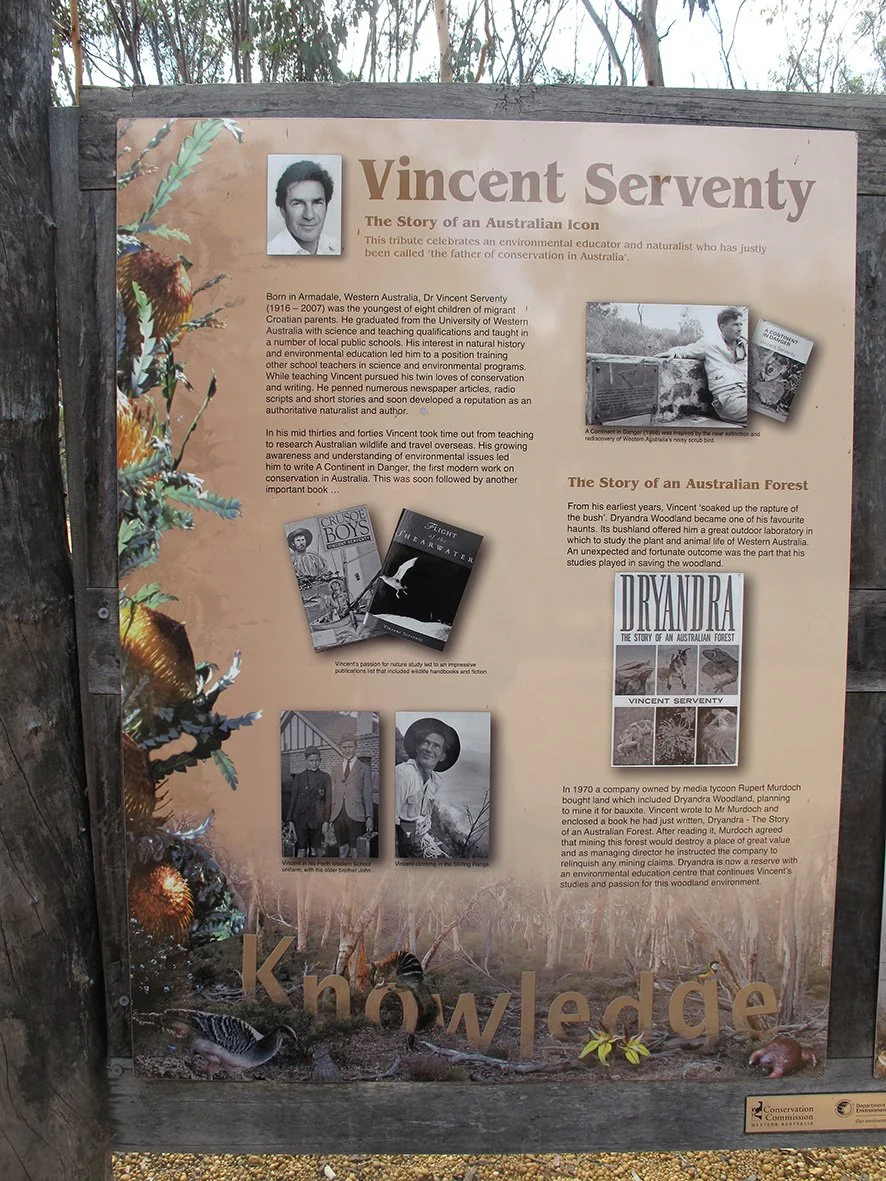
In the 2000s, camping for many a summer on the mid-north coast of NSW with Vincent and Carol Serventy’s daughter Natasha and her family, we were to discover an unexpected Croatian connection to the renowned proto-environmentalist (who, incidentally, I was fortunate enough to meet late in his life). Both Vincent’s and Denise’s father Eric’s forebears migrated from the same small Dalmatian island of Brač, off Split, and arrived in the WA goldfields in the early-20th century. They probably even knew (or at least knew of) one another. Honestly … bloody migrants … what would we do without them?!%$#